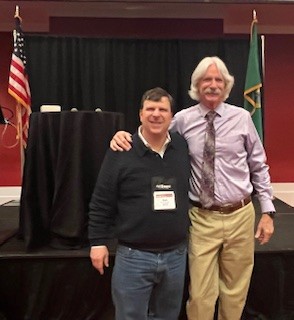
2/26/2026 3:31 PM – Jerry Mahun, PLS – A Wisconsin surveyor since 1979.
Jerry does Mentoring Mondays – https://jerrymahon.com
Original Spice Girls? – In India, 5 gals killed a man over a boundary dispute.
Learning Objectives:
- How boundaries are created; Characteristis
- Where the Rules of Construction come from
- How gaps and overlaps are handled
- Description interpretation issues: Ambiguities; Controlling/informative terms
A. Jerry mentioned Stare Decisis and Common Law and how that works with respect to the Apealate Courts.
B. Statute of Frauds – the contract must be in writing.
C. Boundaries
Are either created or re-established
1. Creation
Controlled by statutory law.
Examples: Subdivisions; Condominiums; Small land divisions; Cemeteries, etc. …
Regulations may define:
Minimum lot sizes, maps, descriptions, monumentation, survey accuracies
USPLS: Federal level letters
1855 – First Manual
2009 – Latest Manual
Procedures, survey accuracies, monumentation, documentation, etc.
Are either created or re-established?
Re-establishment seeks to re-create a boundary in its original location …
A resurvey collects evidence and surveyor evaluate and surveyor evaluates it to determine original corner locations.
Re-establishment is controlled by common law.
Provides evidence evaluation framework
Evidence quality and quality are paramount.
A. PARENTAGE
How boundaries are created affect: (a) Description type; and (b) How are gaps and overlaps handled.
Boundary Creation – Establishes boundary once and forever; creates adjoiner relationship(s); location is “without error,” and creates evidence framework for later re-establishment.
Creation methods – (a) Simultaneous; (b) Sequential; and (c) Combination.
(a) Simultaneous: Boundaries created at the same time by the same legal instrument have equal standing – i.e. No Senior/Junior Rights Relationship.
(b) Sequential: New parcels created independently from the same parent over time … The Earlier created boundaries have precedence (senior) over later created ones (junior).
(c) Combination: New parcesls created by combination of simultaneous and sequential processes… New boundaries can have characteristics of either or both. Senior-junior standing may or may not exist. Note: Description type – Quai-metes and bounds; “of”.
A. Rules of Construction (RoC)
Evidence framework established at original boundary creation,
Deed (written intent) and (possibly) physical monumentation.
Over time, evidence added and removed based on human and natural
Collateral evidence is secondary, often derived from original evidence.
EXAMPLES: FENCES, STREETS, REPLACEMENT MONUMENTS, PAROL, ETC.
At boundary re-est, evidence may conflict – So, how to resolve.
Evaluation Guide
- Rights of possession (unwritten rights)
- Senior right (in cases of overlap)
- Written intentions of the parties (description)
- Call for survey
- Call for munuments; adjoiner
- Direction/distance
- Area/Coordinates
NOTE: If the elements conflict, RoC indicates their relative weight … BUT, this is not strict, it’s overlall guidelines; Description wording can change order; As can evidence type and character; if higher elements are lost, lesser ones carry greater weight.
B. Rights of Possession: Unwritten Rights
Based on adjacent owners’ actions/inactions
Ownership departs from description … Doctrines:
- Adverse Possession
- Prescription
- Oral Agreement
- Equitable Estoppel
- Recognition and Acquiescence
Ownership determined by courts / Surveyors doesn’t have authority / Map deed and use (along encroachment) lines.
C. Senior Right: Gap or Overlap
Precedence establishment – Once boundary is created, Sr-Jr relationship is established and doesn’t change unless boundary is legally removed. Question: Is a boundary attribute, not an owner attribute.
“Child” inherits “parent’s” Sr-Jr standing along shared boundaries.
Parent is junior to children – parent must provide.
>or= 2 adjoining children from common parent-overlap/gap potential …
Sequential – Along sr-jr boundaries: (a) sr parcel protected in case of an overlap – the junior parcel yields; (b) If excess, then what happens with the gap? Answer: Touch situation: Give to one parcel or other or split between?
[Add Slide Info]
Combination – Parcel boundaries may or may not have sr-jr relationships: Example – Sequentially: “West 100.00 ft if Kit 12” kater “East 100.0 ft of Lot 12”.
D. Written Intent
1. Description
a. Description interpretation – Simultaneous: references to map or plat … Unless errors on map, intent relatively clear.
Sequential or Combination: narrative descriptions
Archaic terms, “ancient” measurements”
Written by non-surveyors
NOTE: Surveyors must follow common law principles to interpret & apply description.
b. Controlling and Informative Terms
c. Ambiguities
- Latent – Hidden, not apparent until application. Note: May need evidence to reconstruct location.
[2. Missing Slide]
3. Monuments & Corners
4. Measurements – (a) Distance & Direction; (b) General direction – informative term.
What is a conflict? Often when there are two corners where there should be one … look at the description, it might mean that the sequence of considerations get reordered.
5. Area/Coordinates
[b] Coordinates, even with GPS, are derived quantities. Historically, not included or were informative. “Times achangin’: [Example provided of a metes and call description]
6. “More or Less” – Don’t use this general language.
7. Quasi Metes and Bounds (QM&B) – Combination Conveyances QM&B description have their own issues: Easy to write and among the most ambiguous.
2/26/2026 5:01 PM – Concluded.